The Mature Generations And Sustainability: A Hidden Force?

The Mature Generations And Sustainability: A Hidden Force?

The Mature Generations And Sustainability: A Hidden Force?

April 2025, By Katie Brown

For years, sustainability has been the domain of Gen Z, with their metal straws, oat milk, and ability to call out corporations on TikTok in under 30 seconds. Meanwhile, the assumption has been that older generations are just bumbling around, still figuring out how to switch their TV from HDMI1 to HDMI2. But is that really fair? Are the mature generations truly disengaged from sustainability, or do they just have a different way of showing it?

A DIFFERENT APPROACH TO SUSTAINABILITY

Let’s be honest, sustainability isn’t new. The mature generations were upcycling before it had a fancy name. They called it “hand-me-downs.” They didn’t do fast fashion; they did “wear it until it falls apart.” And forget the current obsession with zero-waste shopping— The mature generations had the original refillable milk bottles and Tupperware that’s been around since the ‘70s (I still vividly remember my mum throwing Tupperware parties—a sea of women, yellow lids everywhere, and a questionable amount of Liebfraumilch flowing).

However, rather than shouting about sustainability on social media, the mature generations have built it into their everyday lives. Growing their own food? Check. Refusing to throw anything away because “it might come in handy one day”? Absolutely. They may not be marching in climate protests, but they’re quietly living a lifestyle that’s arguably more sustainable than many of today’s eco-conscious trends.

THE POWER OF THE OLDER CONSUMER

Here’s where things get interesting. While younger generations get most of the attention when it comes to sustainability, the real spending power lies with The mature generations. And where they put their money matters. Brands that dismiss them in favour of trendier demographics could be missing out on a major opportunity.

The mature generations aren’t necessarily swayed by the latest eco-trend, but they do value quality, practicality, and products that last. The key to winning them over? Show them how sustainability fits into their lives in a meaningful way—without the guilt trip.

CHALLENGES AND OPPORTUNITIES

Of course, it’s not all plain sailing. The mature generations are sceptical of big corporations, and they’re not easily won over by slick marketing. They’ve seen it all before—remember when margarine was meant to be healthier than butter? Exactly.

Some key frustrations include:

  • Feeling irritated when others don’t make an effort (looking at you, person who still doesn’t recycle!).
  • Being baffled by TV shows making sustainability look effortless (sure, I’d love to compost, but where exactly do I put the bin in my tiny kitchen?).
  • Spotting contradictions—like flying in “sustainable” avocados from across the world or eating out-of-season produce wrapped in plastic.

But this presents a huge opportunity. The mature generations want to know their actions matter, and they appreciate practical solutions. Brands that focus on tangible impact, local initiatives, and genuinely useful products will find a willing audience.

LOOKING AHEAD: THE MATURE GENERATIONS AND THE FUTURE OF SUSTAINABILITY

Older consumers are far from disengaged; they’re just doing sustainability their way. And as their influence grows, their purchasing decisions will shape the market more than ever. They may not be flaunting their latest eco-swap on social media, but they’re making choices that count.

Our latest SDSS (Say Do Sustainability Study) highlights the evolving role of The mature generations in the sustainability movement, revealing how their values, habits, and purchasing power are shaping the future of conscious consumerism. Their approach may be different, but their impact is undeniable.

The key to engaging The mature generations? Make sustainability relatable, practical, and useful. Less virtue-signalling, more common sense. Less preaching, more demonstrating how it fits seamlessly into their lives. Do that, and you’ll unlock one of the most powerful consumer groups out there.

And let’s be honest—if they can figure out how to work Netflix, they can figure out how to be sustainable too!

HOW MM-EYE CAN HELP

At MM-Eye, we specialise in helping brands connect with key consumer groups—including The mature generations—through meaningful insights and actionable strategies. Whether you’re looking to tailor your sustainability messaging, refine your product offerings, or better understand this influential demographic, our research can help you navigate the landscape with confidence. Get in touch to find out how we can support your brand’s journey towards sustainable success – Contact us today at info@mm-eye.com or use the form below to book a consultation.

Our Impact and Business as a Force for Good

Our Impact and Business as a Force for Good

Our Impact and Business as a Force for Good

March 2025, By Meg Rudman-Walsh

With March being B Corp Month, what better time to publish our latest Impact Report? MM-Eye has achieved so much over the past few years, and today, we want to share how our commitment to employee ownership, sustainability, and community impact is shaping our business.

Employee Ownership and B Corp Certification

In 2022, we took a transformative step to become 100% Employee-Owned. This decision was driven by a desire to be sustainable not just economically, but also socially and environmentally.

Alongside employee ownership, MM-Eye proudly achieved B Corp certification, a milestone that aligns with our values and commitment to responsible business. Being both employee-owned and a B Corp has allowed us to build a progressive business structure that benefits everyone involved, our team, clients, suppliers, and the wider community.

This structure fosters a culture of ownership, where every team member has a voice in business operations and shares in the company’s success. It has transformed the way we work, encouraging a mindset where everyone thinks and acts like an owner, sparking creativity, innovation, and collaboration at every level.

Creating a Thriving and Inclusive Workplace

From apprentices and recent grads to senior management, everyone at MM-Eye is empowered to contribute their best ideas. Our collaborative approach ensures that each project is tackled with a sense of responsibility and integrity, creating an inclusive, dynamic workplace where people genuinely enjoy what they do.

Beyond our workplace culture, we are committed to diversity, equity, and inclusion. We proudly support the MRS Inclusion Pledge and actively work to foster an environment where everyone feels valued. In 2023, we introduced Partner PAL, a peer-assisted learning and social engagement initiative that includes book clubs, game meetups, and well-being activities to support personal development and team connection.

Our Commitment to Sustainability and Community Impact

At MM-Eye, sustainability is embedded in everything we do. We advocate for environmental responsibility and climate action, having signed the MRS Climate Pledge and committed to reducing our carbon footprint.

We calculate and offset our carbon emissions in partnership with Ecologi, supporting climate projects such as renewable energy generation and forest protection. We are actively working towards becoming a net-zero company, with a comprehensive reduction plan in development. We give back to our local community, offering all team members three paid volunteer days annually, supporting causes close to their hearts.

Our Positive Change Initiative, launched in 2022, focuses on three key areas: personal development and well-being, community engagement, and environmental responsibility. These commitments are not just policies—they are part of who we are.

Empowering Clients with Insights for a Sustainable Future

At MM-Eye, we also recognise the need to stay ahead of shifting consumer trends and support businesses in making informed, sustainable decisions.

Insight Lens is our series of insight decks providing an in-depth analysis of key topics shaping the future of business, leveraging the latest market intelligence.

Say Do Sustainability Study (SDSS) is now in its third year, exploring national views on environmental and sustainability issues. Using our AI-driven tool, ThoughtScape, and sustainability segmentation, we provide deep insights into consumer perspectives. Our brand index helps organisations drive their sustainability efforts forward, positioning brands at the forefront of the sustainability movement.

Both Insight Lens and SDSS reflect our commitment to supporting businesses in making decisions that benefit people, planet, and profit.

A Business Built for Positive Change

I truly believe that MM-Eye demonstrates that businesses can thrive while being socially and environmentally responsible. With a focus on employee ownership, sustainability, and community engagement, we are not just a business, we are a force for positive change.

But don’t just take our word for it. Read our latest Impact Report and get in touch if you or your business are on a similar journey. Whether you are exploring Employee Ownership, B Corp certification, or sustainability initiatives, we are always happy to share ideas and collaborate with like-minded organisations.

Contact us today at info@mm-eye.com or use the form below to book a consultation.

Redefining AI: The Shift from Buzz to Business-Centric Strategies

Redefining AI: The Shift from Buzz to Business-Centric Strategies

Redefining AI: The Shift from Buzz to Business-Centric Strategies

March 2025, By Vitalija Narstyte

The Big Data & AI World event in London is an essential platform for industry leaders, innovators, and decision-makers. This year, the event took a different direction from last year’s focus on generative AI. While the last couple of years witnessed a surge of interest in creative language models and automated content generation, this year’s discussions shifted towards the broader strategic integration of AI into business ecosystems, highlighting responsible deployment, data governance, and the practical challenges of scaling AI initiatives.

In my view, this shift represents a welcome change in the way we approach AI. The reduced emphasis on sensationalist, instant rewards favouring a more holistic, long-term growth strategy is refreshing and necessary for sustainable innovation.

From Hype to Holistic Integration

In recent years, generative AI has dominated headlines, sparking excitement about its potential to transform creative processes and revolutionise content creation. A prime example was the widespread media frenzy surrounding ChatGPT, where bold claims suggested that this tool would immediately replace human creativity and streamline content production overnight, a promise that ultimately proved more hype than reality.

However, as the market matured, stakeholders began to recognise that AI’s true value lies not simply in its ability to generate content but in its capacity to drive significant business outcomes. This year, the event’s key themes reflected this shift, focusing on integrating AI within the existing technological landscape. Discussions ranged from the necessity of a robust data infrastructure to the ethical considerations that must underpin any successful AI strategy.

As someone who has followed these developments closely, I believe that moving away from the hype allows us to focus on AI’s real-world challenges and opportunities.

Strategic Priorities in the Evolving AI Landscape

Several strategic priorities emerged as central themes at the event. First and foremost was the necessity for sustainable and scalable AI strategies. Industry experts emphasised that while generative AI has its place, the broader business value now hinges on operational excellence and integrating AI-driven insights into everyday decision-making. The emphasis on operational integration signals a maturation in the AI landscape, where the focus shifts from experimental applications to long-term strategic planning.

Another significant trend discussed was the rising importance of data governance and ethical AI. With increasing regulatory scrutiny and public concern over data privacy, companies are more than ever compelled to ensure that their AI systems are transparent, secure, and compliant with emerging standards. I believe this focus on ethics and governance represents a necessary evolution, aiming to build a good reputation and customer trust.

Implications for Businesses

The insights from this year’s event carry significant implications for businesses. Companies are encouraged to adopt a more nuanced approach to AI implementation that balances the pursuit of innovation with the practicalities of integration, security, and compliance. The shift away from a singular focus on generative AI means businesses must invest in comprehensive data strategies, ensuring that their data assets are reliable and well-governed. Furthermore, the evolving landscape necessitates upskilling the workforce. As AI becomes more embedded in day-to-day operations, employees at all levels must be equipped to interpret and act on AI-driven insights.

How MM-Eye Can Help

At MM-Eye, we recognise that navigating the complexities of today’s AI landscape requires more than merely adopting the latest technology, it calls for a strategic, holistic approach. Our expertise in data intelligence and analytics uniquely positions us to assist your business in harnessing the power of AI. We collaborate closely with you to design bespoke strategies integrating advanced AI solutions into your existing workflows. Whether you are just beginning your AI journey or seeking to scale your current initiatives, MM-Eye offers customised insights and end-to-end support to drive sustainable business growth.

If you are interested in learning more about how tailored AI solutions that transform your operations and pave the way for long-term success, contact us today at info@mm-eye.com or use the form below to book a consultation.

STEM Needs Women: How Do We Close the Gender Gap?

STEM Needs Women: How Do We Close the Gender Gap?

STEM Needs Women: How Do We Close the Gender Gap?

February  2025, By Vitalija Narsyte 

Women have been pioneers in science, technology, engineering, and mathematics (STEM) for centuries, making groundbreaking contributions that have shaped our world today. The International Day of Women and Girls in Science is a powerful reminder of our invaluable role and the pressing need to bridge the gender gap in STEM careers.

Despite the growing awareness and initiatives to encourage more women to pursue STEM careers, the gender gap remains a significant and urgent issue. Globally, women make up less than 30% of researchers, and gender biases in hiring, promotion, and funding continue to be prevalent. In the UK, women represent only 24% of the STEM workforce, and just 35% of STEM students in higher education are female, highlighting the pressing need to address the gender imbalance in these technical fields.

What’s Holding Women Back?

Societal norms and stereotypes discourage many young girls from pursuing STEM subjects from an early age. Research indicates that girls as young as six years old begin to associate intelligence more with men than women, which can deter them from considering careers in STEM. I was lucky, as I had a natural interest in math and science as a child and was encouraged by my dad to pursue my curiosity. However, I know that many girls do not receive that same encouragement, and this lack of support can have a lasting impact, shaping their confidence and career choices.

The latest Institute of Engineering and Technology (IET) research further highlights the key barriers preventing women from entering STEM fields. According to their findings:

  • 45% of women are not encouraged to consider STEM careers in school.
  • 32% are put off by how male-dominated the industry is.
  • A third of STEM professionals feel that not enough progress has been made in reducing gender-based discrimination in the workplace.
  • Fewer than half (48%) believe achieving gender diversity in STEM is possible.

These statistics highlight the systemic challenges hindering gender equality in STEM, demonstrating the urgent need for targeted interventions to create a more inclusive environment.

The Role of Intersectionality in STEM Disparities

While addressing the gender gap in STEM is critical, it’s equally important to recognise the role of intersectionality. Intersectionality is the way different aspects of identity, such as race, ethnicity, socioeconomic background, disability, and sexual orientation, overlap to create unique experiences of discrimination or privilege. Understanding and addressing these intersecting challenges is crucial to achieving gender equality in STEM.

For instance, women of colour in STEM face compounded barriers, experiencing both gender and racial biases that affect hiring, career advancement, and funding opportunities. In the UK, Black women make up just 1.8% of the STEM workforce, and research has found that ethnic minority women in STEM are less likely to receive promotions compared to their white counterparts. This is just one example of how intersectionality can create unique experiences of discrimination in STEM fields.

Recognising these intersecting challenges means that solutions must go beyond gender equality alone. Creating more inclusive policies, fostering diverse role models, and addressing systemic biases in recruitment, retention, and leadership opportunities will ensure a more equitable STEM landscape for all. This approach gives hope for a future where everyone, regardless of their gender or background, can thrive in STEM.

Why Does Gender Diversity in STEM Matter?

More women in STEM is not just about fairness; it leads to better research, innovation, and problem-solving. Diverse teams bring broader perspectives and ideas, enhancing scientific and technological advancements. For instance, studies have shown that gender-diverse teams in engineering and tech create more user-friendly designs, as they account for a wider variety of needs and experiences.

How Can We Close the Gender Gap?

As a Data Analytics Manager at MM-Eye, I see firsthand the benefits of an inclusive workplace. MM-Eye (which recently celebrated two years of Employee Ownership) fosters a culture where every voice matters, leading to greater innovation and a stronger sense of shared purpose.

MM-Eye is also committed to fostering internal growth and development, ensuring that our team members, particularly women in tech-focused roles, have opportunities to upskill and advance. As part of this, MM-Eye has actively encouraged and supported women like me in tech-focused roles to undertake data science training, equipping us with the skills needed to drive innovation. Investing in these learning opportunities empowers individuals and strengthens MM-Eye’s capabilities to deliver cutting-edge analytics and insights.

At MM-Eye, we believe that data and insights play a critical role in shaping inclusive workplaces and supporting women in STEM. Our research helps organisations identify barriers to gender equality, understand stakeholder perspectives, and implement effective strategies to drive positive change. Through our work, we support businesses in creating inclusive environments where women in STEM can thrive.

If you’re interested in learning more about how MM-Eye’s research can help your business create a more inclusive workplace and drive meaningful change, contact us today at info@mm-eye.com or use the form below to book a consultation.

Leadership Perspectives: Exploring the Future with Our Managing Director

Leadership Perspectives: Exploring the Future with Our Managing Director

Leadership Perspectives: Exploring the Future with Our Managing Director

February  2025, Interview with Damien Field 

At MM-Eye, we pride ourselves on staying ahead of the curve—whether it’s adapting to new challenges, supporting our clients with meaningful insights, or fostering a culture that values curiosity and innovation. As we step into 2025, we sat down with our Managing Director to reflect on the past year, discuss the opportunities ahead, and explore how the market research industry is evolving.

  1. Looking back at 2024, what have our biggest strengths been and how can we build on these going forward?

The adaptability of our team; to respond to challenges, to devise new and better ways of delivering great insights, to go the extra mile to support our clients. We can build on these by believing in ourselves and the value we add and by continuing to communicate who we are, what we do and what makes us different.

  1. What positive change are you making this year? 

In 2024, I spent a lot of time undertaking qualitative, in-person fieldwork around the world. Something I have not done so much of since the pandemic. This involved meeting inspiring research participants, working with great local partners and spending time with clients. These times were not always plain sailing; we had challenges but worked together to overcome them; I’m looking to retain the positive energy this gave me by meeting more people and spending quality time in person with the people who matter to me.

  1. How do you envision the market research industry evolving over the next 2-3 years

2025 will be my 30th anniversary of working in this industry. Change happens more slowly than you’d expect, and many would hope.

Some of the changes I hope to see over the next 2-3 years are…

  • Improvements in online panel data quality driven by a concerted, industry-wide refusal to accept poor-quality data
  • A new and more diverse generation of senior leaders, continuing the ethos of what makes market research such a great industry to work in but also bringing fresh perspectives
  • Integration of AI into our working practices which add value – sometimes faster, sometimes cheaper, but always smarter
  1. What would be your dream research project to do this year?

I spent much of 2024 working on a dream project; helping a global brand reframe their customer understanding by taking a step outside of the narrow confines of their category.

My 2025 dream project would be to help a small scale UK business, founded with a positive change ethos, to move their business to the next level. I’d like to do this by providing them with market and customer insight that unlocks new audiences and routes to market for them

  1. What are the biggest challenges currently faced by the market research industry, and how do you believe companies can effectively address these challenges to stay competitive and relevant?
  • Attract, nurture and retain people with the right blend of skills to make a successful career in market research
  • How can companies address this? By having a clear purpose and identity, investing in their staff development, transparent internal communication, having positive momentum on the things that matter to people  – great clients, interesting projects, trailing new approaches, sharing in success, rewarding personal and collective progress

At MM-Eye, we believe in evolving with the industry while staying true to what makes us different—our people, our approach, and our commitment to delivering insights that truly make an impact. If you’d like to learn more about how we work and what drives us, contact us today at info@mm-eye.com or use the form below to book a consultation.

Katie’s Veganuary Diaries: A Month of Plant-Based Discoveries

Katie’s Veganuary Diaries: A Month of Plant-Based Discoveries

Katie’s Veganuary Diaries: A Month of Plant-Based Discoveries

January 2025, by Katie Brown

Here at MM-Eye, we like to live our values, and since Planet is one of our core pillars, I decided to take on a personal challenge—Veganuary! As a business, we’re always looking at ways to be more sustainable, and I wanted to see what it would be like to embrace a plant-based lifestyle for a whole month. Would it be easy? Definitely not. Would it be eye-opening? Absolutely!

What follows is my honest (and sometimes chaotic) journey through a snippet of my 31 days of plant-based living. From family sabotage attempts to unexpected wins, here’s how it all went…

Day 1 – A Rocky Start!

After a fun New Year’s celebration, I stumbled into the kitchen, craving a midnight snack. My go-to ham toastie was halfway to the grill when it hit me: Veganuary had officially begun! Gutted doesn’t even begin to cover it.

The first day was tough. My fridge is still stuffed with leftover chocolates and party food from the holidays—definitely not vegan-friendly. I quickly realised I hadn’t set myself up for success with proper research or a stocked plant-based pantry. Note to self: a shopping trip and some serious meal prep are essential before day two. If I’m going to make it through this month, I’ll need more than a plate of veg on my menu!

Stay tuned as I navigate the ups and downs of Veganuary. It’s going to be a learning curve, but I’m excited to give it my best shot.

Day 2 – Learning as I Go

Who knew honey isn’t vegan? I certainly didn’t! It’s made by living animals, which makes it a no-go for plant-based living. Clearly, I’ve got a lot to learn on this journey!

Day two felt a little more manageable. I ventured beyond just eating plain veg, which felt like a small victory. The real challenge came at dinner when the family had a roast complete with ham and pigs in blankets. Saying no wasn’t easy, but I stuck to my plan and enjoyed everything else alongside a lentil-stuffed pepper.

Surprisingly, apart from the tempting little piggies, I realised my favourite part of the meal might actually be the veggies! This experience is teaching me more than I expected—and I’m starting to see that plant-based living can be both challenging and rewarding.

Day 3 – Family Sabotage Attempt!

It didn’t take long for the family to try and throw a spanner in the works. My Veganuary journey has barely started, and already I’m hearing, “You can have a little bit of meat though, can’t you? No one else will know!” and “What crazy thing are you doing now?”

I have to admit, it was tempting to just give in to avoid the comments, but I stayed strong. I calmly reminded them that my decision to go plant-based isn’t about making their lives difficult—it’s about making a positive change for myself, and it won’t affect their dinners one bit!

This little test of willpower has made me even more determined to prove to myself (and maybe a little to them!) that I can do this. Bring on the rest of the month!

Day 4 – The Big Shop

My first big shopping trip as a vegan was eye-opening, to say the least! I’ve come to realise just how stuck in my ways I’ve been when it comes to cooking. I rarely try new recipes—I just stick to what I know.

As a busy working mum, being the only one in the house going vegan, I knew I needed to keep things simple and manageable. Luckily, healthy eating isn’t a big hurdle in our home—we’re already pretty good about that. To ease myself in, I focused on easy swaps: replacing mince with Quorn or beans, piling on plenty of fresh fruit and veg, stocking up on falafel, and, for those inevitable lazy days, treating myself to some plant-based bean burgers.

It feels like a small step, but I’m already learning how to make this transition work for me without overcomplicating life. Let’s see how these new ingredients hold up in the kitchen!

Day 6 – Missing Eggs

The last couple of days have gone really well! I’m starting to find my feet, and instead of dwelling on what I can’t eat, I’m actually enjoying exploring all the things I can eat. It’s been a refreshing shift in mindset—but there’s one thing I just can’t stop thinking about… EGGS!

Scrambled eggs, poached eggs, omelettes, and even the classic dippy egg with soldiers—oh, how I miss them! I’ve realised that, while I’m embracing so much of this plant-based journey and might even carry some of these habits forward, giving up eggs is going to be a deal-breaker for me.

Still, it’s all part of the experience, and for now, I’m giving it my best shot. Who knows? Maybe I’ll find a plant-based alternative that comes close… though I’m not holding my breath!

Day 8 – Dairy Confession

Time for a little confession: I might be finding this journey slightly easier than most because I’m lactose intolerant and don’t eat dairy. That said, for years I’ve been a bit selective about what I should or shouldn’t eat—often ignoring the consequences (trust me, you do not want to be around me after I’ve eaten cheesecake!).

This past week, I’ve gone all in and completely cut out dairy, even the occasional bit of chocolate (and yes, I do love chocolate). The surprising part…..or is it? I actually feel so much better for it!

What’s made this even easier is discovering how good the plant-based dessert options are. They might not help with the calorie count, but they definitely hit the spot when I’m craving a sweet treat. Life’s for living, after all! 😊

Day 11 – Out, But Not Out Out

It’s Saturday, and while Veganuary is in full swing, let me assure you—Dry January is not on my agenda. There are limits!!! Supposedly, not all alcohol is vegan, but I’ve decided to stay blissfully unaware for now and enjoy myself.

After a few drinks with the family celebrating my uncle’s birthday, the inevitable happened: talk turned to food. I’d been good all day, sticking to a healthy breakfast and avoiding the bar snacks, but now a takeaway was on the cards. Pizza was out (gave that up ages ago, me and cheese do not get on), so it was off to the kebab shop to see what vegan delights they might have on offer.

Spoiler: not much at all! Watching the staff scramble to find the ingredients for their elusive bean burger was both amusing and a little awkward. They even had a laugh at my expense for daring to go meat-free. But to their credit, once we got chatting, they mentioned they were actually thinking of reviewing their menu to include more vegan options! It’s nice to know that even small choices like this can spark a bit of change—and hey, I got my bean burger in the end, which was surprisingly decent.

Who knows? Maybe next time they’ll have more to offer!

Day 15 – Zumba and a New Routine

Halfway there!! Not a food post today, but definitely an achievement! With all this healthy eating and feeling so much better for it, I’ve been inspired to step up my exercise game—from zero to… well, let’s aim for hero!

Exercise and I have never exactly been best friends. I’ve always struggled to find something I genuinely enjoy, and as we all know, consistency is key—you’re never going to stick with it if you don’t love it. But then, something caught my eye on social media: Zumba!

I’ll admit, I thought Zumba was a thing of the past, but after a little digging, I found it’s alive and well, with some fantastic online platforms offering classes. Since I don’t have time for in-person sessions, 6:30 a.m. in my front room is going to have to do! I’ve signed up, and I’m genuinely excited to start my day dancing!

It’s amazing how this way of living has had such a ripple effect on my life. What started as a month of plant-based eating has now inspired me to move more, try new things, and embrace healthier habits overall. Who knows where this journey will take me next?

Day 18 – Cooking Up a Lentil Curry

I guess its about time I actually talk about something I have cooked!! Cooking new dishes isn’t something I do often (I tend to stick to what I know), but this one looked like something I wanted to give a go!

Armed with a recipe I found online and a pile of spices, I set to work. Chopping onions, garlic, and ginger, sautéing spices until the kitchen smelled incredible—it was all a bit of a faff compared to my usual quick dinners, but so worth it. I even managed to sneak in some extra veg—carrots, spinach, and a handful of tomatoes for good measure.

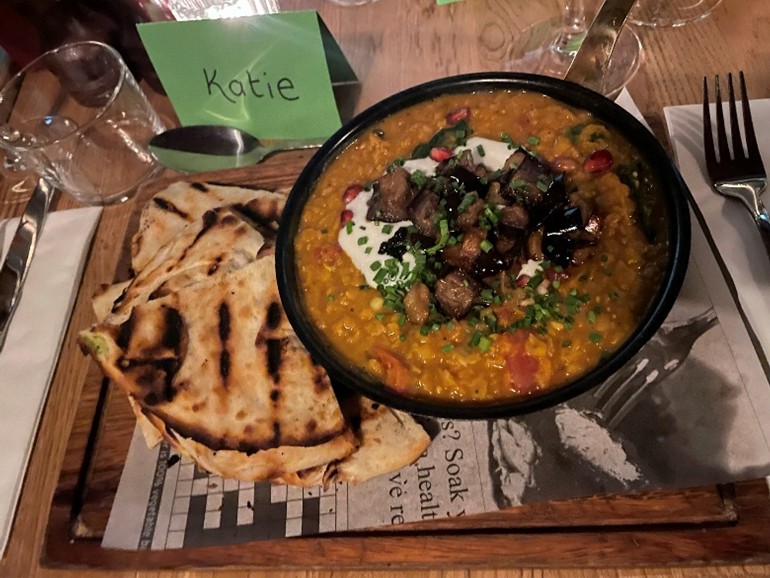
The result? A warm, hearty bowl of comfort food that even the family gave a thumbs-up to (after a bit of initial scepticism, of course). It was satisfying, packed with flavour, and surprisingly filling.

I’m realising that plant-based eating isn’t about sacrifice—it’s about creativity and discovering just how versatile simple ingredients like lentils can be. Now the question is, what do I cook next?


Day 23 – Our fashionably late Christmas Party!

Since December was a whirlwind for MM-Eye, we saved our Christmas party for January—something to look forward to… in theory. But a vegan night out? That felt like a challenge. Or so I thought!

The day kicked off with our AGM, where one of the team had kindly organised snacks—mainly biscuits (cue the envy), but to my delight, she’d also hunted down some vegan salted crackers. Not exactly an easy find, but they were delicious! She wasn’t the only one looking out for me—lunch rolled around, and I was treated to a No Chicken & Chorizo sandwich, a plant-based sausage roll, and even some vegan chocolate. Safe to say, I felt very loved (even if there was some light-hearted teasing along the way).

Next up: Social Darts! If you’ve never tried it, you absolutely should—it’s brilliant fun! And, against all odds, we made it through without any injuries!

Then came dinner—the moment I’d been dreading. Burgers, fish and chips, sausage and mash… animal products everywhere. But to my surprise, my lentil and aubergine curry with flatbread was an absolute winner. So much so that I even skipped dessert (who am I?).

All in all, a cracking night, and I stuck to my vegan journey. Success!

Day 31 – The Final Chapter!

Well, I did it—31 days of Veganuary! It’s been a challenge, but honestly, I’ve enjoyed it far more than I expected. I’ve discovered new foods, tried new recipes, and realised that plant-based eating isn’t as daunting as I once thought.

That said… I need eggs and honey in my life. There are just some things I can’t give up! But I’ll definitely be carrying on with regular vegan days and making more mindful choices going forward.

Beyond the food, this month has left me feeling lighter, more motivated, and with a real appreciation for why so many people choose this lifestyle. In fact, I’ve been so inspired that I’ve signed up for Trek26 with the Alzheimer’s Society—a challenge I probably wouldn’t have considered before!

So, while I won’t be going fully vegan, this journey has changed the way I think about food, health, and even pushing myself outside my comfort zone. Who knows what’s next? But for now—bring on the eggs!

At MM-Eye, our culture isn’t just about what we do—it’s about how we do it, and it’s great to be part of a team that encourages people to live their values in a way that works for them. If you’d like to learn more about our culture and how we put our values into action, get in touch at info@mm-eye.com or use the form below to book a consultation.


Optimising Christmas Retail with AI Solutions

Optimising Christmas Retail with  AI Solutions

Optimising Christmas Retail: AI Solutions for Demand and Sustainability

December 2024, by Vitalija Narstyte

As the festive season approaches, UK retailers prepare for the year’s busiest shopping period. The Christmas season is a time of joy for consumers and a critical period for retailers, with sales often making up a sizeable portion of their annual revenue. Accurate demand forecasting during this time is essential to meeting customer expectations, managing inventory efficiently, and maximising profits. AI solutions are transforming how retailers predict and respond to consumer demand.

The High Stakes of Christmas Retail

December sales can account for up to 20% of a UK retailer’s annual turnover. Misjudging demand risks empty shelves and lost sales and results in overstocking, which has significant financial and sustainability implications. Excess stock often leads to markdowns, wastage, or disposal, contributing to economic losses and environmental harm. Disposing unsold goods increases landfill waste and undermines retailers’ efforts to align with consumer demand for sustainable practices. Traditional forecasting methods, relying heavily on historical sales data and manual adjustments, often fail to address these dual pressures, especially in the face of rapidly changing consumer behaviours and external factors.

Using AI in Managing the Christmas Rush

AI has transformed demand forecasting, offering retailers powerful tools to manage the complexities of the Christmas shopping season. By leveraging machine learning algorithms and big data analytics, AI enables businesses to process vast information from various sources, leading to more precise and insightful predictions.

One key application of AI is analysing historical sales data, uncovering patterns and trends that would be difficult to detect manually. Social media platforms like Twitter and Instagram provide another valuable resource, offering insights into trending or viral products. Economic indicators, including employment rates and consumer confidence indexes, help predict purchasing power, while weather forecasts can significantly influence seasonal buying behaviours, especially for industries like fashion and food.

Several prominent UK retailers have showcased the transformative potential of AI in demand forecasting. For instance, Tesco employs AI to analyse customer data and anticipate product demand, effectively addressing stock shortages and overstocking issues. Similarly, ASOS uses machine learning to predict fashion trends, ensuring the right products are available at the right time. Meanwhile, John Lewis Partnership has integrated AI into its supply chain, leading to improved accuracy in demand forecasting and better product availability during peak shopping periods.

These innovations have yielded significant benefits, including increased sales, reduced operational costs, and enhanced customer experiences.

Challenges and Considerations

Despite its advantages, the adoption of AI in demand forecasting is not without challenges. The effectiveness of AI systems hinges on the quality of the data they process; inaccurate or incomplete data can lead to unreliable forecasts. Additionally, integrating AI technologies requires considerable investment in infrastructure and skilled personnel, which can be a barrier for some retailers.

Data privacy also presents a critical concern. With regulations like the GDPR, businesses must handle customer data responsibly and comply with legal requirements. Addressing these challenges is essential for retailers looking to harness the potential of AI while fully maintaining customer trust.

As more retailers adopt these technologies and navigate the associated challenges, AI will continue to play a pivotal role in shaping the future of retail during the festive season and beyond.

How can MM-Eye help?

At MM-Eye, we leverage our expertise in AI to help businesses across industries meet their operational and sustainability goals. For example, our work with Burger & Lobster focused on harnessing data to anticipate energy demands, reduce waste, cut costs, and support their sustainability goals. Similarly, our AI-driven demand forecasting solutions can empower other businesses to analyse vast datasets to predict customer demand accurately.

MM-Eye’s advanced AI solutions analyse historical sales data, consumer behaviour patterns and external factors such as weather to deliver precise demand forecasts. This enables retailers to stock the right products at the right time, ensuring shelves are filled with what customers want while minimising the risk of overstocking.

Our AI tools can enhance operational decision-making beyond inventory. Businesses can better allocate staff during peak periods by predicting customer traffic and sales volumes, ensuring smooth operations. AI-driven insights can inform dynamic pricing strategies, allowing retailers to adjust prices based on demand patterns. These capabilities ensure retailers stay competitive and maximise revenue during the festive season.

Contact us today at info@mm-eye.com (or use the form below to book a consultation) to explore how our AI solutions can transform your demand forecasting strategy and prepare you for a successful festive season and beyond.


The Power of Ethnographic Research

The Power of Ethnographic Research

The Power of Ethnographic Research

December 2024, by MM-Eye

At MM-Eye, we spend a lot of time helping our clients truly understand the needs and behaviours of real consumers. While quantitative and traditional research methods remain essential, they don’t always capture the full picture of how people live, interact with products, or make decisions in the context of their daily lives. Ethnographic research is a powerful methodology that provides brands with deeper, more actionable insights.

This year, we have had the privilege of conducting in-home visits across the globe, observing consumers in their natural environments. Our travels inadvertently led to some interesting sustainability observations from the MD, which you can read about here: Why get so hung up about hotel towels? – MM-Eye

Our work this year has reinforced ethnography’s unique value in understanding the “why” behind consumer behaviours. Here, we will explore why ethnographic research is an important tool and how it can help your brand achieve its objectives.

What is Ethnographic Research?

Ethnographic research involves observing and interacting with consumers in their everyday environments, whether that’s their homes, workplaces, or local communities. Unlike surveys or focus groups, which rely on reported behaviour, ethnography offers a window into real-life actions and decision-making processes. This allows researchers to capture unspoken needs, cultural nuances, and contextual factors that influence consumer behaviour.

For example, ethnographic research can provide valuable insights into how home infrastructure supports or challenges the transition to electric vehicles. By spending time in consumers’ homes, researchers can see how factors like access to charging stations, energy management habits, or parking limitations influence decisions. This real-world perspective helps brands identify barriers and opportunities that traditional methods might overlook, guiding the development of tailored solutions for consumers navigating this shift.

Why Ethnographic Research Matters

Understanding the “Why” Behind Consumer Behaviour
While surveys can tell you what consumers think and traditional research can tell you how they behave, ethnographic research answers the question of “why.” By seeing how people use products in their natural environments, brands gain an understanding of the motivations, habits, and emotional drivers behind their choices.

Capturing Contextual Insights
Ethnography is great at understanding the influence of context on consumer behaviour. For instance, a consumer might answer a survey saying they prefer eco-friendly products, but observing their home may reveal barriers like the lack of convenient recycling solutions or competing priorities such as affordability. These insights provide richer, more nuanced data that brands can act on.

Innovating with Empathy
When brands understand the lived realities of their consumers, they are better equipped to develop products, services, and campaigns that resonate emotionally. Ethnographic research helps companies innovate with empathy, ensuring solutions align with real-world consumer needs.

Gaining a Competitive Edge
In a crowded marketplace, standing out requires deep consumer understanding. Ethnography provides the type of granular insights that can differentiate a brand. Whether it’s identifying unmet needs, uncovering latent desires, or gaining cultural understanding, this methodology can offer a distinct advantage over competitors relying solely on traditional methods.

How MM-Eye Brings Ethnographic Research to Life

At MM-Eye, we combine ethnographic research with our other methodologies to deliver well-rounded insights tailored to your business objectives. We ensure that the data collected through ethnographic research is robust and reliable. Combining this with our quantitative expertise and quality control measures (read more about how we fight bots in research: Are Bots Ruining Your Surveys? Here’s How We Catch Them! – MM-Eye), we create a holistic view of consumer behaviour that is both accurate and actionable.

Ethnographic research offers unique insights for brands looking to innovate or connect with their audience on a deeper level. Understanding the context in which consumers live, work, and make decisions allows you to develop solutions that are relevant, impactful, and aligned with real-world needs.

At MM-Eye, we pride ourselves on delivering insights that drive positive change. Whether through ethnography, surveys, or tailored research studies, we provide our clients with the tools they need to understand their consumers fully and make informed decisions.

Ethnographic research allows us to step into consumers’ worlds and understand their lives through their eyes and by integrating it into your strategy, you can realise the motivations, barriers, and opportunities that drive consumer behaviour, creating a foundation for better products, services, and campaigns.

If you’re ready to explore the power of ethnographic research and see how it can benefit your business, contact us today at info@mm-eye.com or use the form below to book a consultation.
 

Embracing Green AI: Balancing Innovation and Sustainability

Embracing Green AI: Balancing Innovation and Sustainability

Embracing Green AI: Balancing Innovation and Sustainability

October 2024, by Vitalija Narstyte 

Since the debut of ChatGPT in November 2022, the use of Generative AI has surged across industries. New AI-powered services and products are emerging daily, integrating into our everyday lives and transforming the way we do business. The potential of AI seems limitless. The promise of generative AI to revolutionise industries has generated an unprecedented level of excitement, with businesses eager to leverage its capabilities.

Amidst this enthusiasm, there is growing interest in how AI can help tackle climate change. AI excels at detecting patterns in data, identifying anomalies and similarities, and using historical knowledge to predict future outcomes. This capability makes AI invaluable for monitoring the environment and aiding governments, businesses, and individuals in making more eco-friendly decisions. For example, AI can detect when oil and gas facilities emit methane, a potent greenhouse gas contributing to climate change. Additionally, AI algorithms are being used to optimise energy consumption in buildings, predict weather patterns for renewable energy sources, and even monitor deforestation through satellite imagery.

However, the conversation about the environmental cost of large AI models often gets overshadowed. The more powerful and sophisticated the AI, the more resources it consumes. While it can be challenging to calculate the exact carbon footprint of a single AI model, factors include the energy required to manufacture computing hardware, develop the model, and run it. Training a single GPT-3-like model has been estimated to produce significant CO2 emissions – comparable to the annual emissions of over 100 petrol-powered cars. And that is just for training; deploying large AI models can have an even greater environmental impact. Data centres that house these AI models consume vast amounts of electricity, often generated from non-renewable sources, contributing further to greenhouse gas emissions.

These concerns have led to the emergence of Green AI. Green AI focuses on developing and applying AI technologies that emphasise energy efficiency and environmental sustainability. It aims to reduce CO2 emissions by using and training large models. Researchers and tech companies increasingly prioritise the ecological impact of their AI solutions, seeking ways to make AI more sustainable without sacrificing performance.

Green AI solutions fall into two categories: Mitigation and Oversight.

Mitigation involves creating more efficient models that require less energy. Researchers are exploring ways to compress large models into smaller ones that maintain accuracy but consume less energy. Google’s TensorFlow Lite is an example of a framework designed for deploying lightweight models on mobile and embedded devices, reducing the computational load and energy consumption.

Oversight relates to monitoring and predicting AI’s carbon footprint. This includes developing tools to estimate the energy consumption and emissions associated with AI workloads. Tools like carbon footprint calculators are becoming essential for increasing awareness of AI’s environmental impact. For example, Google’s Cloud Sustainability Calculator helps estimate the carbon footprint associated with using the Google Cloud Platform, allowing businesses to track and manage their emissions. Similarly, the Green Algorithms project provides an open-source tool to estimate the carbon emissions of computational tasks, promoting transparency and accountability.

Balancing energy efficiency with model accuracy can be challenging. However, the trade-off is often worth it when considering the environmental benefits. By focusing on algorithmic efficiency and leveraging hardware designed for low power consumption, It is possible to develop AI solutions that are both effective and eco-friendly.

Embracing Green AI also has significant business advantages. Companies that adopt sustainable practices can reduce operational costs by lowering energy consumption. Moreover, they can enhance their brand reputation by demonstrating a commitment to environmental responsibility, which is increasingly important to consumers.

While AI offers immense innovation potential, it is crucial to consider its environmental impact. By adopting Green AI practices, businesses can continue to leverage the benefits of AI while contributing to a more sustainable future. The transition to Green AI is not just about technology; it is about reshaping business models and strategies to prioritise sustainability.

At MM-Eye, we know that harnessing the power of AI is about making smart, data-driven decisions that align with consumer expectations. Our Say Do Sustainability Study (SDSS) has shown that consumers are increasingly scrutinising the environmental impact of the brands they support. This is why integrating Green AI practices is so important, and we help businesses identify emerging sustainability trends and consumer demands.

If you are interested in learning more about Green AI and how it can benefit your business, contact us today at info@mm-eye.com or use the form below to book a consultation.

 

Are Bots Ruining Your Surveys? Here’s How We Catch Them!

Are Bots Ruining Your Surveys? Here’s How We Catch Them!

Are Bots Ruining Your Surveys? Here’s How We Catch Them!

October 2024, by Hayley Kingston

At MM-Eye, our mission is to help our clients make informed business decisions by investigating what really matters to their customers, employees and stakeholders. We rely heavily on the quality of the data we collect to ensure that we can provide tangible, accurate insights for our clients.

One of the biggest challenges faced by the market research industry at the moment is ensuring the quality of the data we collect. We see fraudulent respondents undertaking surveys and developing technologies, including AI and Language Models, that are used by bots and click farms, meaning that we need to be even more vigilant and stringent with our quality control checks.

To ensure the data we collect is free from sub-par or fraudulent responses, we have established various techniques for “weeding out” these responses at different stages of the data collection process. Firstly, at the survey completion stage, we can implement red herring questions in our surveys, designed to catch respondents who are not paying attention to ensure that respondents are actively reading the questions. In addition to these, we can implement straightlining checks to flag when respondents select the same answer for most or all questions within a survey, as this indicates that they may not be providing attentive responses.

Looking at respondent behaviour is another way we can ensure the reliability of our data during data collection. Several behavioural indicators help us identify whether respondents are providing thoughtful and accurate answers or simply rushing through surveys. For example, the time it takes for a respondent to complete a survey is a strong indicator of response quality. We have an idea of how long a survey should take to complete, so respondents who complete too quickly may not be paying attention or completing the survey appropriately. Therefore, we implement speeder checks in our surveys, screening out responses that fall below a reasonable threshold of completion time.

As well as filtering out low-quality responses within the survey completion, we conduct thorough and ongoing checks throughout the fieldwork period on our open-ended questions. These checks are an essential part of our process to ensure that our data is clean, accurate, and reliable.

Every day, our team manually reviews all open-ended verbatim responses to identify fraudulent responses, bots, or individuals who have not taken the survey seriously. Some of the things we look for are gibberish/keyboard spam, nonsensical answers that do not answer the question we’re asking, and answers that have been copied from the internet or generated by an AI model.

In addition to checking open-ended responses daily, we perform a comprehensive review of the entire dataset weekly. This includes a deep dive into both open-ended and closed-ended questions, using our years of experience to identify broader patterns that could indicate data issues or whether bots/click farm respondents are present.

Maintaining data quality is an ongoing and ever-changing process that requires a combination of preventative measures, real-time checks, and regular reviews. By monitoring respondent behaviour, implementing tools to weed out poor quality responses, and conducting daily and weekly checks, we ensure that the data we collect is both reliable, trustworthy and accurate.

Our goal at MM-Eye is to deliver actionable insights that inform critical business decisions, and these rigorous processes ensure that we achieve that goal with data that we and our clients can trust.

If you’re interested in learning more about our data quality solutions and how they can benefit your business, contact us today at info@mm-eye.com or use the form below to book a consultation.